
The Artisanal Tradition
by Kalila Kaci
A Founding Legacy
The history of eyeglasses dates back to 13th-century Italy. Originally, they were used by monks to alleviate eye strain while reading and copying manuscripts. Gradually, they spread to the nobility. It wasn't until the 15th century, with the invention of printing and the rise of literacy, that eyeglasses became accessible to the general public.
A Nail at the Origin of the First French Eyeglasses
In the 19th century, the Jura region, and in particular the town of Morez, became the beating heart of the eyewear industry in France. This growth was made possible thanks to metallurgical expertise developed as early as the 16th century. In 1796, Pierre Hyacinthe Caseaux, a master nail maker and himself a glasses wearer, revolutionized the sector: he encased lenses in metal wire, thus creating the first French eyeglass frame.
His innovation launched a new generation of industrialists, who experienced a meteoric rise from the 1830s onwards with the production of lightweight frames, nicknamed "wire glasses" or "hair glasses," a specialty of Morez. The region then established itself as the undisputed cradle of artisanal eyewear.
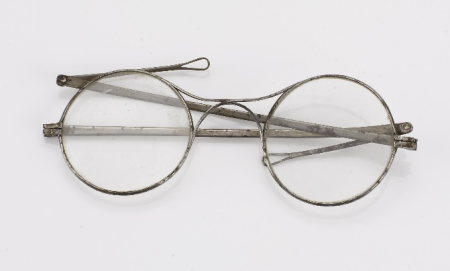
Pair of optical glasses, iron, late 18th – early 19th century © Musée de la Lunette. Photo: Pierre Guénat
Oyonnax: From Comb to Glasses
From the 18th century onwards, Oyonnax exploited the natural resources of the Jura region – wood, horn and hooves – to manufacture combs. The reputation of Oyonnax comb makers then spread internationally, and production exploded: in 1830, there were more than 600 manufacturers.
The invention of celluloid in 1860 marked a turning point. Wood and horn gave way to this new material, propelling Oyonnax into the age of plastics. The town excelled in the manufacture of combs and hair ornaments. But in the 1920s, the fashion for short hair caused a collapse in demand. Craftsmen sought new markets: some converted to making toys, pipes… and soon, celluloid components for the opticians of Morez, who specialized in metal frames.
The arrival of acetate in Oyonnax in the 1940s revolutionized the optical industry. Lightweight, durable, and flexible, this material allowed for the creation of frames in a variety of shapes and bold designs. Oyonnax quickly became a world leader in eyewear. This tradition continues today. The city remains a key center for artisanal creation and innovation in the eyewear sector.

Acetate comb, designed by Patrice Pointet.